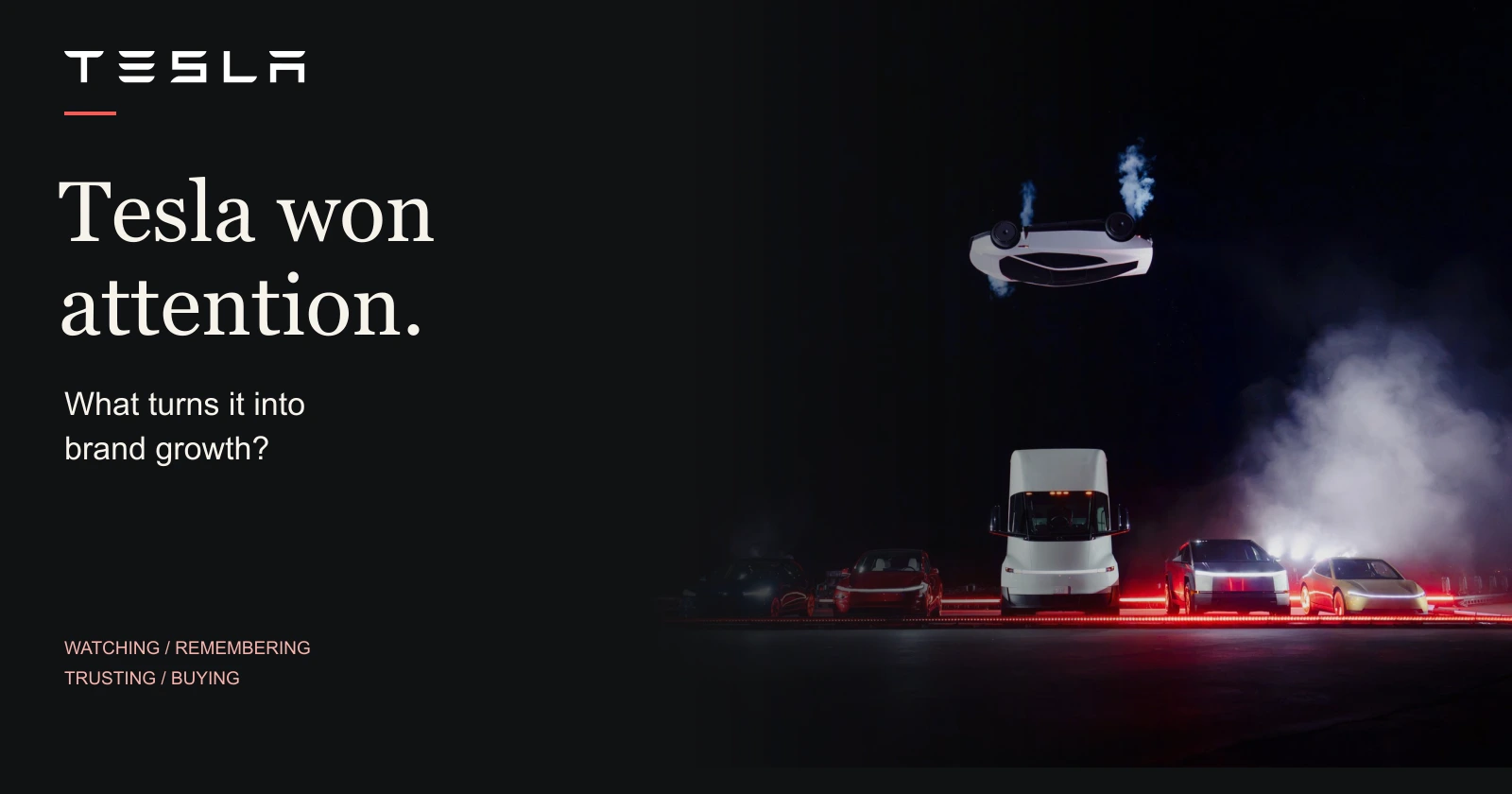
8 min read
Tesla’s Roadster demonstration gives marketers a useful problem: someone can watch a remarkable car stunt, remember Elon Musk, and still have no stronger reason to trust Tesla or buy a car. Attention creates an opening. What happens afterward determines how useful that opening becomes.
I would judge the moment through four questions: Did people watch? What did they remember? What did they believe? What could they do next? Each tells us something different about brand growth.
The Roadster moment: watch first, then look at the brand
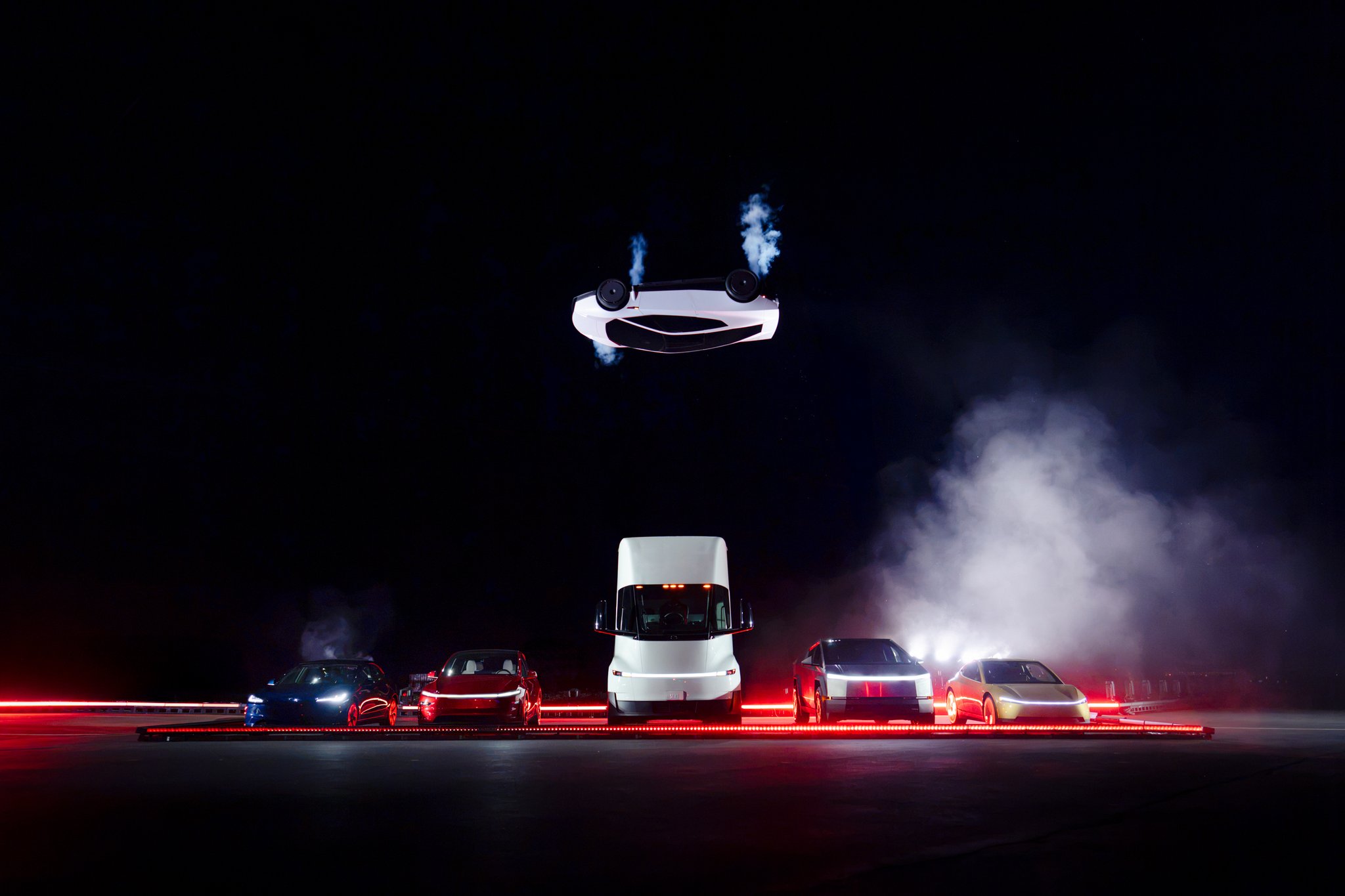
Tesla’s official X post dated 16 October 2026 contains photographs of the demonstration. The separate official broadcast below provides the footage context. This is an analysis of that public material, not Tesla’s internal plans or sales results.
The unusual car catches the eye. But look at the other Tesla vehicles beneath it. That composition raises the more interesting marketing question: can excitement about one flagship improve how people think about the whole brand?
Four different jobs behind brand growth
Watching earns attention. Remembering connects it to a brand. Trusting requires credible proof. Buying adds real constraints such as suitability, price, timing, and availability. People can move between these questions rather than follow a tidy sequence.

An existing owner may trust Tesla before seeing the clip. An enthusiast may enjoy it without needing a car. A future buyer might remember it months later. One engagement rate cannot explain all three responses.
1. Watching: make the short version work
A dramatic demonstration can earn the seconds that ordinary product content struggles to get. The next question is whether the relevant audience notices the brand in those seconds.
The Roadster clip has a clear visual interruption: a car doing something unexpected. But clips travel without their original captions. A repost that keeps the surprise and loses the Tesla connection may contribute more to entertainment than brand memory.

For performance creative, I would compare a brief branded cut with a slightly longer explanation. Check viewing behaviour and relevant reach, then test recall separately. Repeat views are not unique people, and a repost does not necessarily mean approval.
2. Remembering: attach the moment to a useful idea
Attention becomes more useful when people remember the right brand for a relevant reason. “I saw a wild car clip” and “I would consider Tesla for an electric car” are different outcomes.
Mental availability: being thought of when it matters
Mental availability is how readily a brand comes to mind in buying situations. The Ehrenberg-Bass Institute distinguishes this from simple awareness. Recognising a name does not tell us whether someone will think of it when a need arises.
For the Roadster moment, I would test whether it reinforces an association such as engineering ambition, then examine whether Tesla comes to mind in relevant buying situations. Start with unprompted questions before showing the brand or clip. Otherwise the survey supplies its own answer.
In brand strategy, I would choose one association the evidence can support. Asking the same demonstration to prove innovation, affordability, reliability, and everyday practicality gives it too many jobs.
3. Trusting: follow the spectacle with proof
A demonstration can make an engineering claim tangible. Trust in ownership still needs evidence about the product and the company’s ability to deliver.
A viewer might love the Roadster footage and still ask about availability, servicing, or the demonstration conditions. A useful follow-up would explain what was shown, what remains in development, and where current verified product information can be found.
The halo effect: an impression can travel
The halo effect describes how an overall impression influences judgments about particular qualities. A research review hosted by Columbia Business School discusses this issue in marketing measurement.

My hypothesis is that an exciting flagship could make the wider Tesla range feel more technologically ambitious. That carryover needs testing. It would not prove that another model is more reliable or easier to service.
A simple example
A beautifully designed hotel lobby may make guests expect a better room. That first impression helps. The room, cleanliness, and service still have to meet the expectation. A flagship product creates a similar responsibility for the wider brand.
The stronger the promise, the more important the next ordinary experience becomes. Answering a buyer’s concern clearly can do more for trust than another dramatic edit.
4. Buying: give curiosity somewhere useful to go
Curiosity has commercial potential when people can find a relevant product, understand the offer, and take a sensible next step. That does not mean asking every viewer to buy immediately.
I would create different routes for different interests: verified Roadster updates for enthusiasts, relevant model information for people considering an electric car, and clear technical explanations for current owners. These are recommendations, not claims about Tesla’s current offers.
Match the next step to the person
- “That was incredible.” Offer a clear explanation.
- “Could a Tesla fit my life?” Help them compare relevant models.
- “I want to take this further.” Show an available enquiry, test-drive, or purchase route with clear terms.
Keep the destination quick on mobile. Answer the question that brought someone there. Sales will still depend on budget, timing, competition, availability, and the product itself.
The follow-up plan I would build
I would prepare the work around the moment before it goes live. For events and brand activations, the first curious visitor can reach the website while the team is still celebrating.
- Choose one association. Write what the right audience should remember about the brand.
- Create three useful edits. A short branded demonstration, a clear explanation, and an answer to a real buyer question.
- Publish the proof. Separate demonstrated facts from plans and unresolved questions.
- Prepare the destination. Give different interests an appropriate next step.
- Keep a baseline. Measure what changed after the event without assuming the event caused everything.
Measure the job, not just the views
I would use separate measures for attention, memory, confidence, and commercial action. No single dashboard number proves the demonstration caused brand growth.
| Job | Look for | Do not assume |
|---|---|---|
| Watching | Unique reach, viewing duration, relevant audience. | A view means interest in buying. |
| Remembering | Unprompted brand recall and buying-situation associations. | People remember Tesla because they remember the clip. |
| Trusting | Consistent surveys about specific claims and recurring objections. | Excitement proves confidence in ownership. |
| Buying | Qualified enquiries, available test-drive requests, purchases. | The demonstration alone caused the result. |
A traffic spike needs context. Other news, offers, seasonality, and existing demand can affect the same numbers. A properly designed comparison can provide stronger evidence than a simple before-and-after chart. People who choose to watch may already differ from those who do not.
A practical marketing analytics plan should help decide what to do next: improve the explanation, answer a recurring objection, or fix a destination that loses interested visitors.
A smaller-business example: the coffee shop opening
A smaller brand can borrow the connection between a memorable moment, a clear association, and a useful next action. It does not need Tesla’s production scale.

The useful lesson is to give the experience something repeatable behind it: a product people enjoy, service they trust, and a reason to come back on an ordinary day.
Questions about attention and brand growth
These distinctions matter when an engagement report starts being treated as a business result.
Does a viral Tesla video prove brand growth?
No. Views establish exposure under a platform’s counting rules. Tesla brand growth would need evidence relevant to the objective, such as stronger buying-situation associations, qualified demand, or customer growth. Public footage alone cannot establish those outcomes or show that the demonstration caused them.
What is the difference between brand awareness and mental availability?
Brand awareness concerns recognition or knowledge of a brand. Mental availability concerns how readily it comes to mind in buying situations. For Tesla, recognising the name after seeing a Roadster clip differs from thinking of Tesla when considering a suitable electric car.
Can a flagship product help sell other products?
A flagship can influence the overall impression of a brand, but the effect on other products must be tested. Tesla’s Roadster material offers a useful hypothesis about engineering associations. It does not prove that viewers trust another Tesla model more or that sales increased.
Make the next interaction worth the attention
The Roadster material gives us a strong creative moment. I would assess its marketing value through what follows: a recognisable Tesla association, a better understanding of the product, credible answers, and useful action.
Have a question about the work?
Start a conversation