11 min read
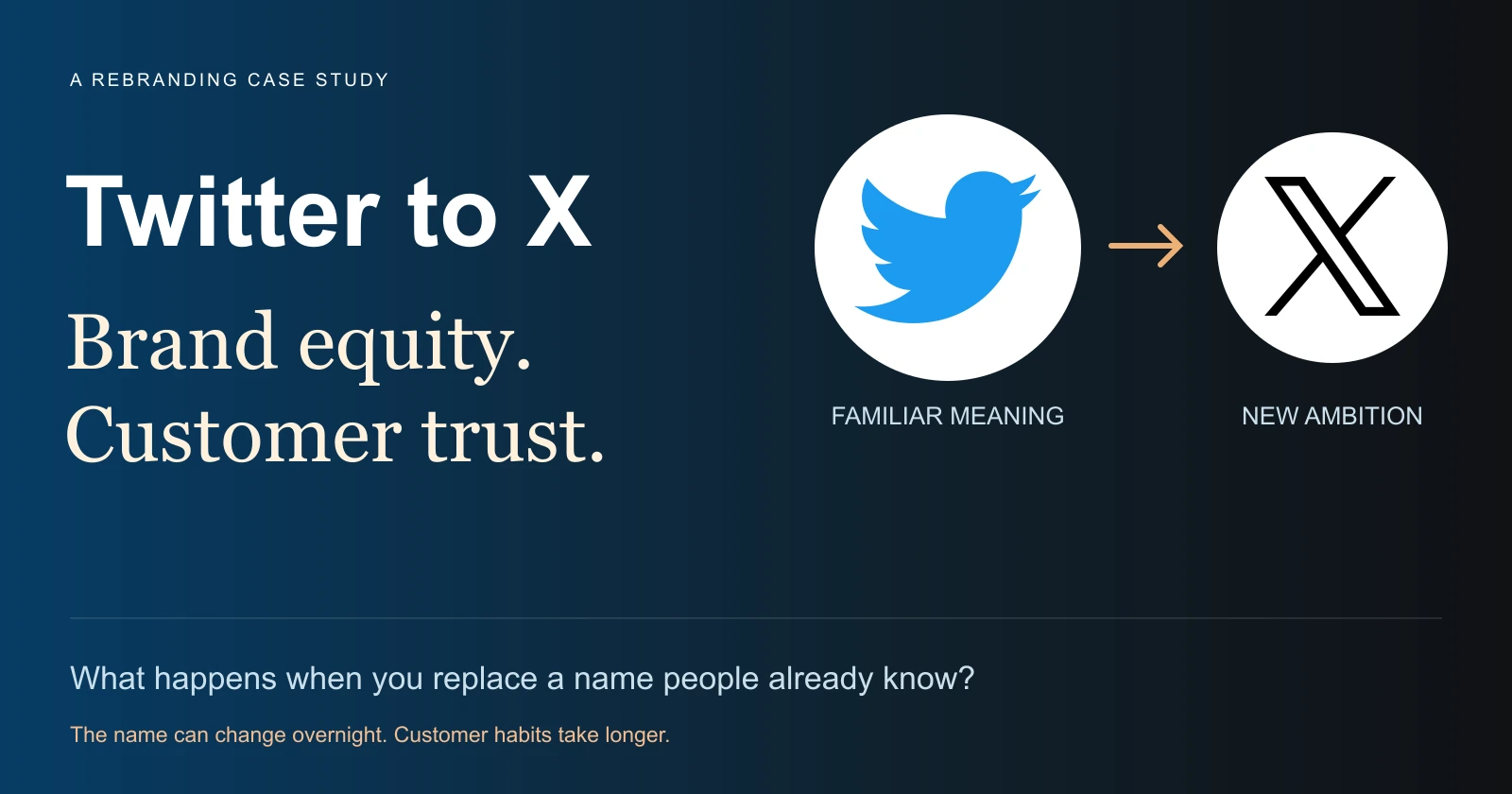
The Twitter-to-X rebrand changed more than a name and a logo. It asked people to replace a familiar identity, a recognisable blue bird, and words they already used with a broader promise about what the platform could become.
That is what makes this case useful for a business considering a new name. You can change the sign quickly. You still have to help customers connect their existing memories with the new identity, understand the reason, and decide whether the experience deserves their trust.
1. What had Twitter built before the rebrand?
Twitter had connected its name, blue bird, and product vocabulary into a recognisable identity. Those elements helped people identify the service and describe what they did there.
In its 2012 announcement of the simplified bird, Twitter said the symbol could represent the service without accompanying text. That was the company’s own assessment of its recognition, rather than an independent awareness survey.
The blue bird also fitted the language: tweets, retweets, and tweeting. A symbol, an action, and a place reinforced one another. Replacing the mark therefore involved more than swapping an app icon.

Brand equity is the value created by what people know, feel, and expect about a brand. Recognition is one part. Familiarity, associations, and preference can matter too. None of those is guaranteed to disappear when a name changes, but each needs consideration in the transition.
2. What happens when a brand enters everyday language?
Familiar vocabulary lets customers refer to a service without explaining it from scratch. Twitter was the platform name; tweet was its associated noun and verb. Calling the company name itself the everyday verb misses that useful distinction.
Oxford’s learner’s dictionary records the social-media use of “tweet” as a verb. People could say “I tweeted it” or “retweet this” and communicate both an action and a platform association.
That gives a brand a place in conversation. It does not establish universal affection, customer loyalty, or a particular financial valuation. People can use a familiar word while disliking the company.
The opportunity is repeated recognition. The risk is asking customers to relearn language they already find useful. X’s help pages now use post and repost terminology. Those words describe the actions clearly, but they do not carry the same bird-related connection.
3. Why did Twitter change its name to X?
The stated reason was a wider product ambition: X was intended to become an everything app
, extending beyond short public messages. That is the rationale to evaluate, rather than guessing at an undisclosed marketing motive.
In his July 2023 explanation, Elon Musk linked the acquisition to that ambition. X’s October 2023 company update described a direction that combined consuming, interacting, watching, and eventually transacting within one interface. These were company statements about its direction, not independent proof of delivery.
My reading is that X offered a less category-specific identity. A bird and a tweet tell a relatively focused story. An abstract letter leaves more room for different services.
That room comes with a cost: the company has to teach people what the new identity means. A broader name can support a strategy, but it cannot explain the strategy or deliver the product by itself.
4. What does a broader identity gain, and what does it risk?
A broader identity can make expansion easier to describe. It can also weaken the familiar cues that help customers recognise a business. Both deserve a place in a brand strategy, before the logo reveal.
| Change | Potential gain | Transition risk |
|---|---|---|
| Twitter → X | A name less tied to short messaging. | Customers need to connect the new name to the service they know. |
| Blue bird → X mark | A clear visual signal of a new direction. | A familiar recognition cue is replaced. |
| Tweet → post | Language that accommodates different content formats. | Distinctive vocabulary becomes more general. |
I would also test an intermediate option: keep the established product name under a broader company identity. That would not necessarily have suited Musk’s strategy, but it is worth considering for a business whose current name still does valuable work.
5. Did customers start calling Twitter “X”?
Adoption was incomplete in a documented US snapshot nearly a year after the change. A YouGov survey conducted on 25–26 June 2024 found that 49% of US adults still called the platform Twitter, rising to 55% among daily X users.

That measures reported name usage, not whether respondents knew the official name. It is also a US result, not a global adoption rate.
The explanatory phrase formerly Twitter was still useful in institutional communication. For example, Pew’s June 2024 research on X used the old name to help identify the platform.
I see that phrase as a bridge between identities. It is not, by itself, proof of failure. The important question is whether the need for explanation is shrinking among the customers a business wants to reach.
6. What practical work sits behind a rebrand?
A rebrand has to reach the places where people find, use, and pay for a business. The announcement, digital migration, and customer learning do not necessarily finish together.
The X identity appeared on the platform in July 2023. Musk’s core-systems domain announcement followed on 17 May 2024. Those are different milestones, not one overnight change.

For a smaller business, I would give each of these an owner and a verification check:
- Domains and links: retain control of the old domain, map important old URLs to relevant new pages, and test bookmarks, account links, and campaign destinations.
- Search visibility: update canonical URLs, internal links, sitemaps, and Search Console settings as appropriate. Monitor old-name and new-name queries, indexing, and errors.
- App listings and interface: coordinate names, icons, screenshots, button labels, onboarding, and help pages. Check whether customers can still find the right product.
- Advertising materials: update active ads, landing pages, partner assets, presentations, and printed collateral. The click should lead to an identity the customer recognises.
- Customer communication: explain the reason, what changes, and what stays. Check email identities, receipts, billing descriptors, support scripts, and account notices.
These are recommended transition tasks, not a claim that X executed every item in this way. For the technical move, Google’s site-migration guidance recommends mapping URLs, using appropriate redirects, and monitoring the move. Rankings can fluctuate as Google processes changed URLs.
My pre-launch site audit guide covers another part of the same job: checking that important destinations and enquiries work before sending people there.
7. How did the visible owner affect the new identity?
Musk’s visibility gave the change a prominent messenger. It also made the brand closely associated with his public behaviour and decisions. Awareness of the person and confidence in the service remain separate questions.
There is a factual distinction here: Musk acquired Twitter; he did not found it. This is an owner-led rebrand, with lessons for founder-led businesses where one person is strongly associated with the company.
A visible leader can explain the change repeatedly and bring attention to it. The same association can make a disagreement with that leader influence perceptions of the product. I would measure those responses rather than assume every follower is a supporter or a customer.

My practical advice is to make the explanation work without the personality. Customers should understand the new proposition from the website, the product, and the support experience, even if they never follow the person leading it.
8. How should we judge whether the rebrand worked?
Judge a rebrand against its goals, using separate measures for recognition, understanding, trust, and business outcomes. A rise in attention does not settle the other questions.
What the advertiser evidence can tell us
Kantar’s September 2024 release reported marketer trust in adverts on the platform at 12%, compared with 22% in 2022. It discussed brand-safety concerns and wider perceptions of the platform. The study included about 1,000 senior marketers globally, alongside its consumer research.
That is relevant historical evidence about advertiser confidence. It does not identify the effect of replacing the Twitter name with X. Changes in policies, verification, content, pricing, leadership, and advertiser relationships could affect perceptions too.
YouGov’s same analysis also showed its composite brand-health Index recovering by May 2024. That measures something different from name usage or advertiser trust. Neither finding alone establishes what the new name caused.
The questions I would put on a rebrand scorecard
A useful marketing measurement plan would ask:
- Recognition: can people identify the new name and logo without a prompt?
- Understanding: can they explain what the business offers and what changed?
- Trust: do they believe the promises that matter to their decision?
- Advertiser or partner confidence: do buyers understand the offer and feel comfortable renewing?
- Business performance: what happened to acquisition, retention, revenue, and the cost of serving customers?
The evidence reviewed here does not establish a commercial return from the name change. That judgment would need comparable financial and customer data, not just attention or survey scores.
Keep definitions consistent and record other major changes. Where feasible, test alternative naming explanations with comparable audiences while holding the product proposition constant. That can isolate a communication effect more cleanly than comparing the whole business before and after a turbulent period.
It would be too strong to call every business decline a naming failure, or every recovery a rebranding success. The evidence here supports lessons about transition and measurement, not a causal verdict on X’s name.
9. What should a business do before changing its name?
Start with a customer problem the new identity can help solve. Then protect the associations that still make the business easy to recognise and choose.
Imagine a bakery called Old Mill expanding into meals and evening service. The owners choose Mill & Table. This is a hypothetical example, not a client case study.

The customer message could be simple: “Now Mill & Table. Formerly Old Mill Bakery. Same team, with lunch and dinner now on the menu.” The company explains the expansion while keeping a familiar point of reference.
Before launch, I would follow five steps:
- Write the reason. Explain what the new name helps customers understand that the old one cannot.
- List what is valuable. Identify the name associations, visual cues, products, and service promises worth carrying forward.
- Test understanding. Ask customers what they think changed. Listen for confusion about ownership, availability, accounts, or quality.
- Plan the transition. Connect the new identity across search, links, interfaces, advertising, and customer communication.
- Measure and adjust. Track recognition and understanding alongside commercial results. Keep the old-name explanation while it remains useful.
This connects with the Tesla case study on attention and brand growth: being noticed, being remembered, and being trusted require different evidence.
Questions about the Twitter-to-X rebrand
These are the distinctions I would keep clear when discussing the case.
Why did Twitter rebrand to X?
Elon Musk linked the change to his ambition for an everything app. X’s company communication described a broader direction spanning interaction, video, and transactions. The intended role of the name was therefore wider than short messaging. That stated ambition should be distinguished from evidence of product delivery.
Was Twitter itself used as a verb?
The most useful distinction is between Twitter, the platform name, and tweet, its associated noun and verb. Oxford records the social-media verb tweet. Familiar expressions such as tweeting and retweeting connected an action to the service, which made the vocabulary part of its recognisable identity.
Did changing Twitter’s name to X cause a loss of trust?
The sources discussed here do not isolate that causal effect. Historical research records advertiser confidence and customer naming habits, while X also changed its product, policies, leadership, and commercial offer. Evaluating the name alone would require a research design that separates it from those other influences.
My take: carry the customer’s memory into the new name
X had a documented reason for seeking a broader identity. Twitter had familiar associations worth accounting for. Both can be true.
If you are considering a rebrand, I would spend as much time planning the explanation and transition as choosing the name. The customer should be able to recognise you, understand the change, and find the experience they were promised.
Have a question about the work?
Start a conversation